People ask us for a “putting green” and usually mean one of two different things. Some want a green built for practice, one that rolls consistently and has enough slope to challenge them. Others just want something fun in the yard, a hole or two, maybe an obstacle, more for the kids on a Saturday than serious practice. Both get called the same thing, but they’re not built the same way, so it helps to know which one you want before we show up.
Grass greens are more upkeep than most people want, mowed short, watered constantly, kept alive with gear most homeowners don’t own. That’s the whole reason almost nobody puts one in at home anymore. Turf takes care of the upkeep side of it, but it doesn’t decide the bigger question on its own, whether you’re building this to practice or just to have fun, and that’s what shapes everything else about the project.
Practice Green or Backyard Mini Golf: What's the Difference?
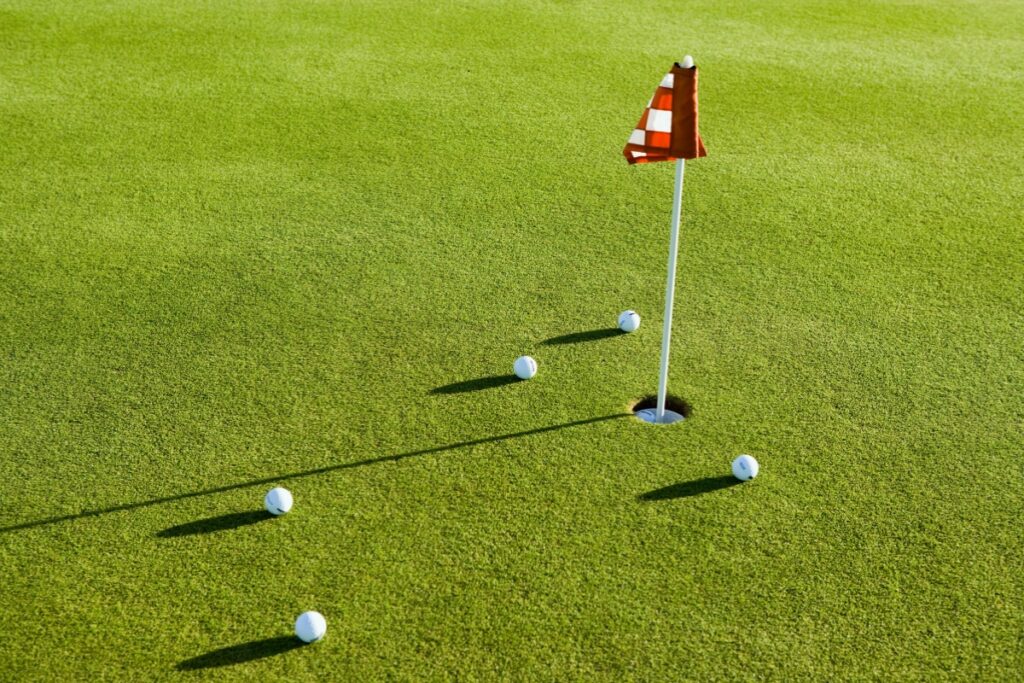
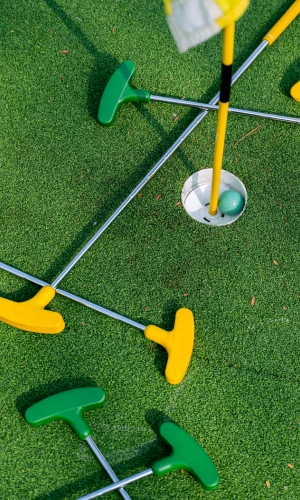
A practice green is all about the roll. The ball needs to move across the surface at a consistent speed, and there needs to be enough slope built in that it feels like putting on a real green, not a flat carpet. It’s a smaller, private version of a real green. Mini golf isn’t after any of that. It’s obstacles, tight turns, and a few holes strung together so people have something fun to do on a Saturday.
Both get built with Dominion Turf’s Golf Turf line, the same short, dense blades either way. What’s different is everything underneath it, the grading, the slope, how many cups and where they go. Most of what we build in Colorado Springs ends up somewhere in the middle, a green with enough real contour for practice that still holds up fine when the kids want to play a few holes. Build it mini-golf-first instead and it usually doesn’t work well for anyone trying to practice seriously.
What Goes Into a Putting Green Installation
The base matters more here than on almost any other turf project. Small inconsistencies in the subsurface can lead to bad rolls on the finished green, in a way they’d never show up on a regular lawn. The USGA’s putting green construction guidelines, written for grass greens on actual golf courses, still shape a lot of the grading and drainage logic backyard synthetic greens borrow, especially around slope percentages that keep the surface fair to putt on, rather than being unpredictable.
Most backyard practice greens work well with gentle contour, 2 to 3 percent for standard cupping areas, enough for the ball to curve naturally as it rolls, without turning every putt into a guessing game. Drainage gets built into the base like on any turf job, graded so water runs off instead of pooling near a cup.
From there the turf gets cut and fit to the design and the cups go in at finished grade. The fringe around the green usually runs a slightly longer pile than the putting surface itself, the same trick real courses use so the green reads clearly against everything around it.
How Big Does a Backyard Putting Green Need to Be?
There’s no real minimum, but size decides what’s possible on the surface. A 200 to 300 square foot green fits into a lot of standard Colorado Springs backyards and handles one or two cup locations with some gentle slope. Push into 400 to 600 square feet and you’ve got room for multiple cups and more varied slopes, the kind of variety a serious golfer wants to practice with.
Mini golf works differently. Size comes down to how many obstacles and holes you’re after, not putting variety, so a single hole with a fun feature can fit into a much smaller footprint than a true practice green needs.
Integrating a Putting Green With Your Existing Yard
Most homeowners aren’t ripping out the whole yard for a putting green. They’re adding one next to a standard residential lawn, and Dominion Turf builds both in the same installation, residential turf for the main yard and Golf Turf on the side, with a clean transition between the two instead of an obvious seam where one stops and the other starts.
Frequently Asked Questions About Backyard Putting Greens
How much does a backyard putting green cost compared to a regular lawn installation?
More per square foot than standard residential turf, because of the added base precision, contouring, and cup work involved. Exact pricing depends on size and how many cup locations and slope variations you want, and we’ll give you a real number at the estimate based on your yard.
Do I need a large yard to have a putting green?
No. A modest green in the 200 to 300 square foot range fits most standard suburban lots in Colorado Springs and still gives you real practice value. Mini-golf-style setups can work in even less space.
How long does a backyard putting green last?
Dominion Turf’s Golf Turf product carries a 15-year warranty. Regular brushing and the occasional infill top-off keep the surface playing true well past that.
Can kids use a putting green built for serious practice?
Yes, without any trouble. It’s mostly the true mini-golf builds, the ones loaded with obstacles and multiple holes, that don’t work well for anyone trying to practice seriously.
Does a putting green need special maintenance compared to regular turf?
Some. It needs occasional brushing to keep the pile consistent for a true roll, and infill levels matter more here since even a small low spot throws off the ball. Beyond that it’s the same low-maintenance routine as any other turf.
Can I add a putting green to an existing yard without redoing the whole lawn?
Yes, and it’s the most common request we get for golf turf. The green gets built as its own zone, with a clean transition into whatever’s already there or going in alongside it.
Thinking about a putting green for your Colorado Springs yard? Request a free estimate and we’ll talk through size, layout, and whether you’re building for practice, play, or both.